Thursday, 16 June 2016

WS ABC Part 10: Actors' Companies

After a traumatic month which included a bereavement, a stroke (followed by a fantastic recovery) and an attack of kidney stones, I'm now back on top and ready to go. So let's continue with our WS ABC and ACTORS' COMPANIES.


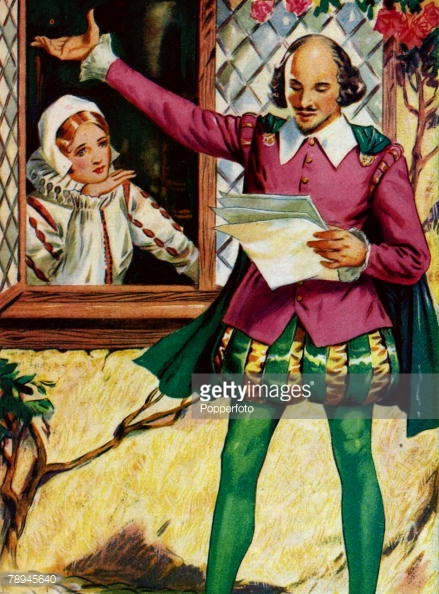
Since actors were equated a bit higher than vagabonds, doxies and prostitutes, during WS's time, they would band together to form actors' companies under the patronage of a lord or an important person in authority. The actors would invest in the company which then used this money to buy costumes and props as well as to pay the playwright. This meant that our Will received about six or seven pounds for each of his plays. (A pound then was worth at least 250 times of its current value.)

Shakespeare, who was a shareholder in the Globe theatre, noted this in Hamlet:

Hamlet: Would not this, sir, and a forest of feathers...get me a    
               fellowship in a cry of players, sir?
Horatio: Half a share.
Hamlet: A whole one, I.

Those actors, usually about ten, who invested in the company were called 'full adventurers' or 'sharers.' A well-known sharer was John Heminge who became the business manager in the Lord Chamberlain's company and in 1623 was one of the two compilers of the First Folio. These sharers would then employ non-sharing actors - 'hirers' who were paid about six shillings a week. The sharers would also employ boy actors (i.e. before their voices had broken) to play the female parts as women were not allowed to act on the stage until after the Restoration of Charles II in 1660. (Much of the plot of Shakespeare in Love is based on this last fact.)

                                             Leicester

One of the first actors' companies was the Earl of Leicester's Men. This company was established in 1572 and as the earl was Elizabeth I's favourite, she granted them a royal patent. James Burbage, the first real impresario, built the first purpose built theatre, called 'The Theatre' in Shoreditch, north of the City of London, in order to stage Leicester's productions. When the earl died in 1588, his company merged with Lord Strange's company.
                                           Lord Strange

Lord Strange (Earl of Derby)'s company tended to tour the provinces and it is known that they performed in Stratford-upon-Avon in 1578. Perhaps this is where the fourteen year old WS caught the 'theatre bug'? They also performed at Burbage's Theatre as well as at the Rose Theatre, a theatre deliberately sited on the south bank of the Thames beyond the authority of the City Fathers. This company may have performed some of WS's early plays. When Lord Strange died in 1594, (theories that he was poisoned as a Catholic),  the company left London for the provinces, although several of the actors may have remained behind to join the rival company, the Lord Chamberlain's Men.
                                                  Hunsdon

This last named company was the most important one during the late Elizabethan-Jacobin period. This company was founded by Henry Carey, Lord Hunsdon (patron of Emilia Bassano-Lanier, 'the Dark Lady' of the Sonnets?) in 1564-7 and when he became the Lord Chamberlain, the company known as Hunsdon's Men acquired its new name, the Lord Chamber-lain's Men. 
                                                James I

When Elizabeth I was succeeded by James I in 1603, this company became the King's Men and continued to be the most important actors' company. It is recorded that WS was a shareholder in the company from at least 1595 and he continued to write (and act?) for them until he retired in about 1613. This company at first acted at Burbage's Theatre and then after 1599 it occupied the newly constructed Globe theatre on the south bank. 
     Site and plaque for Curtain Theatre, Shoreditch London

Its most famous actor was Richard Burbage, the son of the impresario. The King's Men performed one play a month at court on average and in 1608 bought the Blackfriars Theatre, a building with a roof (unlike the Globe) which enabled the actors to perform all year round. The King's Men continued to stage plays until they were forced to close down by Cromwell after the Civil War in 1649.  


                                               Howard

Another major actors' company was the Admiral's Men. This was founded in 1576-9 by Lord Howard who became the Lord High Admiral in 1585. Their most famous actor was Edward Alleyn (see previous blog) and the manager was Philip Henslowe (famous for the detailed theatre records he kept of this period.) The Admiral's Men went into decline when Alleyn retired in 1604 and was finally disbanded in 1631.

Next blog will start on the B's of this WS ABC and will be about Macbeth's buddy, Banquo.

Personal note: Thank you to all the readers who sent me messages of condolence or wishing me well (healthwise) during this last somewhat traumatic month.

wsdavidyoung@gmail.com 

Sunday, 5 June 2016

Back to WS ABC Part 9 - Edward Alleyn

After the past tragic fortnight, I am pleased to continue with compiling my WS ABC and talk about EDWARD ALLEYN, one of the great Elizabethan actors.

Alleyn was born in London in 1566, the son of an inn-holder and porter to Queen Elizabeth I. By the age of 17 he appeared as an actor with the Earl of Worcester's Company and then moved on to act with the Lord Admiral's Company and Lord Strange's Men. He acted at the Rose Theatre (nr. the Globe) on the South Bank under the management of Philip Henslow, the late 16th century theatre manager and impresario. (As I couldn't find a picture of the original Henslowe, the one played by Geoffrey Rush in Shakespeare in Love will have to suffice!)

The last time Alleyn acted was in 1604 soon after Prince Henry, the son of James I, took over the Admiral's Men acting company. Alleyn's last public appearance, (though maybe not as an actor) was in the coronation procession of the newly crowned King James I in 1604. After he left the world of drama, Alleyn kept up his financial interest in the Fortune Theatre and he also inherited Henslowe's share in the Hope theatre.  

Alleyn's major acting roles included: Tamburlaine, The Jew of Malta, Barabas and Doctor Faustus, all from Marlowe's plays. He also acted the role of Orlando in Robert Green's play as well as acting the part of Hieronimo in the Spanish Tragedy by Thomas Kyd as well as acting in plays by Nashe and Dekker.  
He was considered one of the leading actors of his day and was famous for his "tragic style." In addition he was also an accomplished musician.

On his retirement he bought the manor of Dulwich in south-east London for nearly 10,000 pounds  (well over a quarter of a million pounds in today's money) and here he settled down in 1613 - the same year that WS probably returned to his wife and family in Stratford for the last time. Alleyn founded Dulwich College - 'the college of God's gift - an educational institute that still exists today (see Google). In order to help his college financially, he endowed it with the freehold of the Fortune Theatre.
                                    Dulwich College today

He continued with his philanthropic acts and patronage of the arts and in 1623 (the year Hemminges and Condell published WS First Folio, ) he married Constance, his second wife. She was the daughter of the poet and Dean of St Paul's, John Donne. (Donne was famous for his sermons and the two quotes: "No man is an island, entire of itself" and "...for whom the bell tolls.") Alleyn's first wife, Joan, was Henslowe's step-daughter. he had married her in  October 1592 but she had died in the meanwhile. 
Alleyn's first wife, Joan


                                                                                                                                                 Alleyn's gravestone


Alleyn's Memorial Window


Next time I will deal with Elizabethan Acting Companies.
Incidentally, you can also read of a clash between Edward Alleyn and Shakepspeare in my novel, Welcome to London, Mr. Shakespeare.

For reactions, please email: wsdavidyoung@gmail.com


same name.

Wednesday, 25 May 2016

My last memorial blog for Nadav: "Give sorrow words."

This is going to be my second and last blog in memory of my son, NADAV AVRAHAM YOUNG, (3 July 1978 - 19 May 2016) who died in a domestic accident last week.
                              My favourite picture of Nadav

This blog will also serve as a genuine heartfelt 'thank you' to all the people who took the time and trouble to personally console me and my family during this terrible period. That means it is addressed to the tens of people who came to our house and also to all of the others who sent us email messages of condolence. Please regard this blog as a personal and individual way of saying 'thank you' for your support.

These past few days when we have been sitting shiva - the traditional seven days of mourning in the Jewish religion - have given me time to think about two important aspects of mourning. The first one of course was the mourning for my son, Nadav, and the second one was to think about the nature of mourning and how we cope with death.

Apart from sitting shiva for my parents and my older sister, Frances, I have not had much experience of sitting shiva.
However, it was THIS shiva which made me think about the essence of this tradition i.e. how we Jews mourn and how other religions cope with this situation. Buddhists and Hindus believe in different variations of embalming and cremating while Quakers have very few strict rules about memorial rites. They believe that the dear departed should be the subject of a thoughtful "meeting for worship" as opposed to the Irish wake style of memorial. Moslems, like Jews, believe that apart from the saying of specific prayers and the carrying out of certain rituals, the deceased should be buried as quickly as possible after they have died if the circumstances allow.

This Jewish tradition of the shiva is based on the Old Testament, (Genesis 50: 1-14) when Joseph buried his father, Jacob, before sitting for seven days in mourning. As a continuation of this ancient tradition, during the shiva today the bereaved family sit on low chairs, do not go to work and the men refrain from shaving. 

All of this was new to me when I attended my first shiva. This was in honour of a schoolfriend's father who had died when we were both thirteen years old. I was very loath to attend. I expected to be drawn into a very sad household where everyone would be crying and the atmosphere would be unbearably heavy. Instead, I saw that everyone was sitting around normally and talking about all sorts of things while mentioning what my friend's father had done during his life at the same time. "Why isn't everyone sad and crying?" I asked myself, but then didn't give the shiva too much thought afterwards as I was busy growing up.

Today I understand the importance of this tradition. By not going to work during this seven-day period and by abandoning the normal routine of life, you are able to think more about the deceased (in my case, Nadav) while at the same time it also allows your friends and family to visit you and pay their respects. I have found that this act of 'visiting' and 'hosting' to be mutually therapeutic and supportive. It enables all of those who come to commiserate with you on your loss to do so in a quiet and calm atmosphere - an atmosphere which helps to give strength and support to everyone involved. To quote from Macbeth when Malcolm is consoling Macduff over the murder of his family "give sorrow words: the grief that does not speak whispers the o'erfraught heart." This Shakespearean quote reflects much of the essence of the shiva.

And so I am taking this opportunity to thank all of those who contacted me, both personally or electronically, during this past week, and helped me "praise what is lost" and make "the remembrance dear." 
                                                                                      יחי זכרו ברוך

                                                                      David
                                                                      dly-books.weebly.com


Saturday, 21 May 2016

WS: "Grief fills the room up of my absent child

            This blog is dedicated to my son - 
              NADAV AVRAHAM YOUNG
whose untimely demise occurred on May 19th.
                                       Nadav aged eleven

Although I wrote in my last blog a few days ago that this one would be about the Elizabethan actor, Edward Alleyn, fate - "the stars above us [that] govern our conditions"(Lear IV,3) - hath intervened and declared otherwise.

Two nights ago, my son, Nadav, saw that he had forgotten or misplaced the key of his flat in Tel-Aviv late that night. He had returned from where he'd been working at the theatre and decided to try and get into his flat through the outside balcony. Unfortunately he slipped and fell into the garden below. If there's any chink of comfort in this story, it's that he didn't suffer as he died instantly. He was 37 years old, unmarried and a popular and talented musician.

As I said at his funeral, it is against the natural order of things for a father to bury his son, but that is what happened. What is natural for me, that is, was to turn to Shakespeare to see how I could express myself with regard to this tragic situation.

Death appears in many guises in WS's plays. According to several sites on Google, the majority of deaths in the Bard's works are the results of stabbings (e.g. Duncan in Macbeth, Claudius in Hamlet and also in Julius Caesar,) death by sword and/or combat as in Macbeth, Richard II & III.  Suicide also occurs as in Romeo and Juliet and Ophelia in Hamlet, as well as death by smothering as that of  'the true and loving, gentle' Desdemona in Othello. Another grim death is that of Cordelia, 'the precious maid.' She dies by being hanged by her enemies at the end of King Lear, a play in which her royal father also dies, but he dies of a broken-heart.  

Shakespeare even wrote about a fake death: the 'death' when the spurned Hero in Much Ado pretends to die in order to regain Claudio's love.
                                Nadav and his sister, Vered

However, these deaths for Shakespeare were vicarious and didn't affect him personally. Apart from the death of his younger eight year old sister, Anne, the one death we know that did influence him was that of his son, Hamnet. This young lad died aged eleven in August 1596. It has since been claimed by many that the following lines said by Constance, the mother of the murdered young Arthur in King John probably reflect Shakespeare's own grief over the death of his young son. These lines were written in 1596-97.

                   Grief fills the room up of my absent child,
                   Lies in his bed, walks up and down with me,
                   Puts on his pretty looks, repeats his words, 
                   Remembers me of all his gracious parts,
                   Stuffs out his vacant garments with his form: 
                   Then I have reason to be fond of grief.

I am now grieving my own son's death. What makes this even harder is that Nadav's death was completely pointless. It did not achieve anything. No-one gained from it but many people including his many friends and family certainly lost by it. As Shakespeare said at the end of Macbeth in that fantastic speech beginning, Tomorrow, and tomorrow, and tomorrow about life and death, life

                  'is a tale,
                  Told by an idiot, full of sound and fury, 
                  Signifying nothing.'

Nadav's life was not pointless. His death was.
                                                                     
                                                                     David, May 22nd. 2016 


Sunday, 15 May 2016

Shakespeare ABC - Part 8 - Anne Hathaway

Contrary to what is usually written about the life of our William, Anne Hathaway may not really have been the real name of Mrs. Shakespeare.

When he married her in November 1582, the record in the local Register for the granting of a special licence states that 'Willelmum Shaxpere et Annam Whateley de Temple Grafton may lawfully solemnise matrimony together.' This licence, issued by the Bishop of Worcester, was special as it was issued during Lent when marriages were not normally solemnised.
An idealised picture of William Shakespeare, the family man.

However, on the following day, Fulk Sandells and John Richardson, both from Anne's village of Shottery signed a bond which exempted the bishop from all liability if there should be any irregularity in the speeded up marriage between William Shagspere...and Anne Hathwey of Stratford in the Diocese of Worcester. It has therefore been concluded that this Whateley/Hathaway record was written by a careless clerk.
Was this the Bard's wife? The classic but posthumous picture of Anne Hathaway.
The reason for the speeding up of this wedding was that the future Mrs. Sha(x/gs)pere was heavy with child, and in fact gave birth to the couple's first daughter, Susanna, six months later.
Or was it this Anne Hathaway?

Apart from this minor detail, what else do we know about the Bard's wife? Not much really. The first time she is mentioned in the Stratford-upon-Avon's parish records is when our Will registers his intention to marry her. He did so, because as I've already said, she was pregnant and the question of love and marriage was irrelevant. In those days, if the alleged father was able to, he had to marry the young lady. This meant that the new-born child would have parents to care for it and the local parish would not be responsible for its future. 

Anne Hathaway is thought to have been the illiterate daughter of Richard Hathaway, a local farmer. She was born in Shottery, a small village west of Stratford-upon-Avon in 1556. We know she was born then because on her gravestone in Holy Trinity Church it says that she was 67 years old when she died in 1623.
From this we conclude that she was 26 years old on her wedding day and that our Will was eight years younger. In addition to giving birth to her first daughter, she also bore twins two years later in 1585. They were named Judith and Hamnet.

Apart from being the Bard's wife, Anne Hathaway's name is generally connected with the cottage bearing her name. This cottage, which is one of the most visited tourist sites in the UK, was originally an Elizabethan farmhouse. It was bought by Anne's brother, Bartholemew in 1610 and has been linked to Anne Hathaway since the late 18th century. In 1892 the Shakespeare Birthplace Trust bought it and they maintain it until today.

Anne Hathaway's other well-known claim to fame is that in WS's will, she receives his 'second-best bed.' This is one of the most famous clauses of the most famous will ever. Experts have generally decided that she received this second-best bed, not because the Bard was particularly mean to his spouse, but that this was the bed in which he would have enjoyed his more intimate moments with his (sometimes estranged?) wife. The first-best bed would have been the one reserved for visitors. 


Finally, AH may also appear at the end of Sonnet 145. Here, various lit. crits have suggested that our William was not very pleased to have been forced into a shot-gun wedding and so expressed himself  poetically thus:
              
                  'I hate from hate away she threw,
                   And saved my life, saying 'not you.' 

                                   &&&&&&&&&&&

Next time I will deal with the famous Elizabethan actor: Edward Alleyn.              

Friday, 13 May 2016

Shakespeare ABC - Part 7, "As You Like It."

As You Like It  in a poetic nutshell:
                   
                    "As You Like It" isn't 'real' -
                   But the pastoral ideal
                   (Deeply rooted in our senses)
                   Speaks to modern audiences.
                   Sell your house and go abroad...
                   Buy somewhere you can afford...
                   What provides the motivation?
                   Lower levels of taxation?
                   Legacy? Retirement?
                  In this play it's Banishment! ***

As You Like It (hereafter AYLI), a play which pokes fun of the conventions of romantic love, is often thought to be one of WS's best comedies. It also explores the evils of primogeniture, the system where the oldest son gets all the property leaving the other siblings with nothing but their big brother's (possible) generosity.

The play also exploits the 'pastoral' convention, e.g. people wearing disguises. An extreme example of this is where Rosalind dresses herself up as a man and then role-plays herself back again in order to teach Orlando how to woo her.

This play, which has been described by critic John Russell Brown as a 'light-footed gaiety, warmth and confidence' was probably written in 1599-1600 during a period of a wish to return to the pastoral life - 'to fleet the time carelessly, as they did in the golden world.' Therefore, it is not surprising that most of the action takes place in the Forest of Arden, a Warwickshire forest well-known to the Bard. (See my previous blog entry.) It was also good luck that this play was included in the First Folio (1623) as it wasn't included in any of the quarto editions.

The Plot: Celia's father, Frederick has usurped the rightful duke who is Rosalind's father. Rosalind remains at court with her friend and cousin, Celia, but then is later banished with Celia to the same forest. Orlando, a young noble meets Rosalind in disguise and falls in love with her, but when he hears that his older brother, Oliver, plans to kill him, he also flees to the forest.  There Rosalind persuades Orlando to pretend  that she is really Rosalind, and to make love to her. Later she tells him the truth and is restored to her father and marries Orlando.

At the same time, Celia is paired off with the now repentant Oliver while Touchstone pairs off with Audrey and Silvius does the same with Phebe. In the end, Duke Frederick repents of his original usurpation and, restores Rosalind's father as Duke Senior. In Shakespearean tradition, this comedy is all very complicated and in my eyes at least, not very credible.

Even if most people don't know this play well, they'll certainly know the beginning of one of its most-quoted speeches:

                              All the world's a stage
                             And all the men and women merely players.
                             They have their exits and their entrances;
                            And one man in his time plays many parts...

And from here on, Jaques, a cynical, sentimental malcontent goes on to set out the seven stages of a man's life from the 'mewling and puking' infant to the 'mere oblivion' of the aged man. This life-journey travels via the 'whining school-boy', the 'lover, sighing like a furnace,' 'the soldier... seeking the bubble reputation,' the justice with his 'fair round belly' to the lean and slipper'd' sixth ages with his 'spectacles on nose and pouch on side' and 'his shrunk shank.' 

The idea of comparing life to a stage was not an original Shakespearean one and he may have been aware of Pythagoras who said the same some two thousand years earlier. In addition, WS's theatre, the Globe may have used the motto, Totus mundus agit histrionem' - All the world plays an actor, a phrase attributed to the Roman courtier, Petronius in the first century C.E.

The fact that WS used this idea in AYLI  was also not a first for him. About five years earlier in 1594-5 in The Merchant of Venice, WS has Antonio say,

                              I hold the world but as the world, Gratanio;
                             A stage where every man must play a part,
                             And mine a sad one.

Ten years later in Macbeth, WS returns to the idea of life being like a play, when at the end of the play, the world-weary Scottish king in my favourite speech in my favourite play says in Act V, sc.5:

                            Life's but a walking shadow; a poor player
                           That struts and frets his hour upon the stage
                           And then is heard no more.

And now you'll hear no more from me until next time when I'll deal with Mrs. Shakespeare, alias, Anne Hathaway (or was that her real name?)
Tell me, if all the world's a stage, how come all the clowns are     
                                employed in this office?

For comments etc, please write on my Facebook page or send to: wsdavidyoung@gmail.com Thank you.

***From: Shakespeare in a Nutshell:A Rhyming Guide to All the Plays by James Muirden, Constable, 2004

Saturday, 7 May 2016

Shakespeare ABC part 6: References to Arden

The name ARDEN is often associated with Shakespeare's life and writing. This is usually in connection with the Forest of Arden or with WS's family, especially on his mother, Mary Arden's side.

The Forest of Arden is an area in Warwickshire, 'Shakespeare's County', as the local road signs proudly proclaim, in the centre of England. According to Norrie Epstein in The Friendly Shakespeare,  this forest is:                                    
  
a sylvan sanatorium for the politically exiled, the lovelorn, and assorted undesirables. It's not like any geographical place, its topography being a fantastical mixture of flora and fauna, including snakes, lions and palm trees. Anything can appen in what the actress Janet Suzman calls "this improbable forest where a lot of crazy people are having an engagement party.
                                    In the Forest of Arden

 'Billets-doux grow' on trees, one woman falls in love with another, an evil duke undergoes a miraculous conversion, and feuding brothers are suddenly reconciled...[In "As You Like It"] Celia finds a husband,Touchstone finds a wife, and Rosalind is reunited with the banished father and the lover she thought she'd never see again.

Arden was also the surname of WS's mother, Mary, who married John Shakespeare, a probably illiterate glover, who traded in among other commodities, barley, timber and wool. He made himself a good catch as Mary Arden came from a rich Catholic family, but this religious aspect of their life was to prove potentially dangerous in the future. Mary gave birth to eight children: Joan, Margaret, William, Gilbert, Joan, Anne, Richard and Edmund. Unfortunately, the first Joan died very young and her sister, Anne, also died young at the age of eight.
Like WS, his youngest brother, Edmund, also became an actor and was buried (aged 27) at Southwark, near the Globe theatre.
                    Shakespeare musing in the Forest of Arden

Other members of the Arden family include Thomas Arden of Wilmcote, a village near Stratford-upon-Avon. He bought an estate in nearby Snitterfield which he bequeathed to his son, Robert, (Mary's father) in 1547. When Robert died nine years later in 1556, he left his chief property at Wilmcote and over six and-a half pounds (probably worth somewhere between 500-1,000 pounds in today's money) to Shakespeare's mother.
The Tudor house in Wilmcote nr. Stratford allegedly owned by     
                                     Mary Shakespeare.

The house at Wilmcote, billed as 'Mary Arden's cottage' is a major tourist attraction. However, in the spring of 2002, Dr. Nat Alcock wrote in the Shakespeare Quarterly  that he'd discovered in the house's deeds  and the local church records that the house was in fact owned by an Adam Palmer.

Next time I will write about the play, "As You Like it."